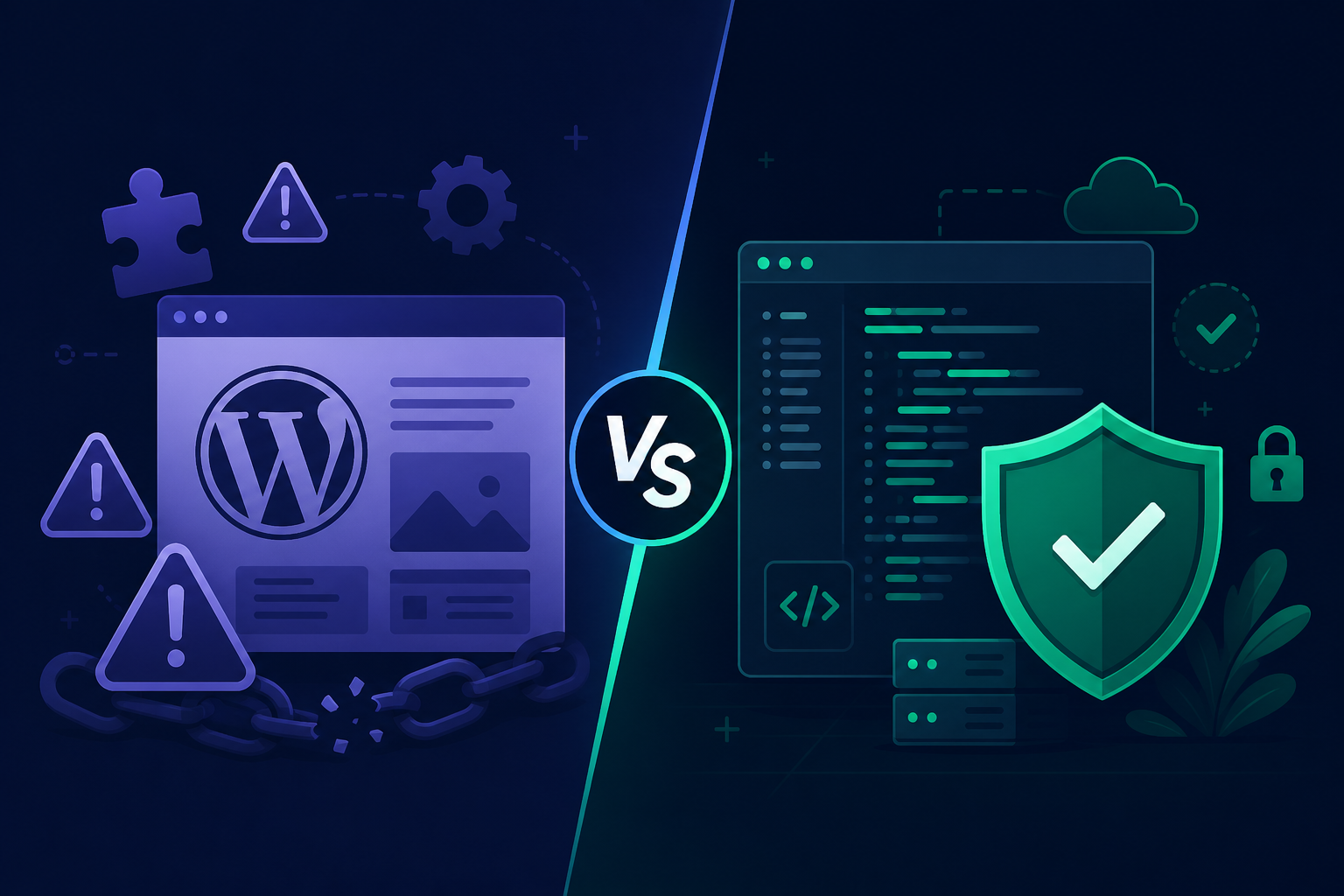
WordPress powers a huge share of the internet—and for good reason. You can install it in minutes, pick a theme, add a few plugins, and have a site live by the end of the day. No deep technical knowledge required. For a personal blog or a simple brochure site, that accessibility is a genuine advantage.
But easy to launch is not the same as safe to run. If your website handles customer data, payments, internal workflows, or your brand’s reputation, the same qualities that make WordPress popular also make it one of the most targeted platforms on the web. Here’s an honest look at the trade-offs—and why custom development is often the better long-term choice for serious businesses.
Why WordPress is so easy (and so popular)
WordPress earned its place by lowering the barrier to entry:
- One-click installs on most hosting providers
- Thousands of themes and plugins for almost any feature
- A large community of tutorials, freelancers, and agencies
- Low upfront cost compared to a fully custom build
For many use cases—a blog, a portfolio, a small local business site—that combination is hard to beat. You don’t need a development team. You don’t need to write code. Almost anyone can get something online quickly.
That simplicity is real. We’re not here to dismiss it.
The hidden cost: security at scale
The flip side of WordPress’s openness is a massive attack surface. Because the platform is so widely used, attackers treat it like a gold mine: one vulnerability can affect millions of sites at once.
Here’s what makes WordPress especially risky:
1. It’s the #1 target on the web
WordPress runs roughly 40%+ of all websites. Attackers don’t need to guess what stack you’re on—they assume WordPress and start probing. Automated bots scan the internet 24/7 for:
- Outdated WordPress core versions
- Vulnerable plugins and themes
- Default login URLs (
/wp-admin/) - Weak passwords and exposed admin accounts
You’re not being singled out personally. You’re on a platform that criminals optimize their tools for every single day.
2. Plugins and themes are the weakest link
Most WordPress sites depend on multiple third-party plugins—contact forms, SEO tools, sliders, ecommerce, page builders. Each plugin is a separate piece of code, often maintained by a small team (or abandoned entirely).
When a plugin has a security flaw:
- Your site can be compromised even if WordPress core is up to date
- You may not know a plugin is vulnerable until after an attack
- Fixing it means updating, testing, and hoping nothing breaks
Custom development doesn’t eliminate all risk—but it removes the dependency on dozens of unknown codebases running on your production site.
3. Updates are a constant chore—and easy to skip
WordPress security depends on continuous updates: core, themes, plugins, PHP version, hosting environment. Miss an update, and you’re exposed. Apply updates blindly, and something often breaks—especially on sites with heavy plugin use.
Many small businesses fall behind. The site “works,” so updates get postponed. That’s exactly when breaches happen.
4. Shared patterns make exploitation easier
WordPress sites share the same structure, file paths, database schema, and admin interfaces. When a new exploit is discovered, attackers can deploy it at scale within hours. Custom-built applications don’t broadcast their architecture—there’s no universal playbook for breaking in.
What a WordPress breach actually costs you
Security isn’t abstract. A compromised WordPress site can lead to:
- Stolen customer data (emails, accounts, order history)
- Malware injection that redirects visitors or steals card details
- Google blacklisting and loss of search traffic
- Downtime during cleanup—often days, not hours
- Legal and reputational damage, especially if you handle personal or payment data
Recovery means forensic cleanup, password resets, plugin audits, and sometimes a full rebuild. The “cheap and easy” platform suddenly becomes expensive.
When WordPress still makes sense
We’re not saying WordPress is always wrong. It can be a reasonable choice when:
- You need a simple content site with no sensitive data
- You have someone who will maintain updates and backups consistently
- Budget is extremely tight and the risk profile is low
- You’re running a personal project, not a business-critical system
The problem is when businesses treat WordPress as a default—without weighing security, growth, or integration needs.
Why custom development is the stronger choice
Custom development means your site or application is built for your business, not assembled from generic parts. For organizations that take security and performance seriously, the benefits are substantial:
Smaller attack surface
No unnecessary plugins. No bloated theme code. Only the features you actually need—written, reviewed, and maintained as part of your project.
Security by design
Authentication, data handling, and access control are built into the architecture from day one—not bolted on via a plugin that may or may not be maintained.
No dependency roulette
You’re not waiting for a plugin author to patch a critical vulnerability. Your codebase is yours: auditable, version-controlled, and updated on your schedule.
Performance and scalability
Custom sites aren’t dragging dozens of scripts and styles you never use. They load faster, rank better, and scale with your business without hitting plugin limits.
Exact fit for your workflow
Need a booking system tied to your CRM? A client portal? Multi-language content with RTL support? Custom development delivers exactly what you need—without forcing your process into a plugin’s assumptions.
How to decide: a simple framework
Ask yourself:
- Does this site handle sensitive data? (Customers, payments, accounts, internal tools) → Lean custom.
- Can we commit to ongoing WordPress maintenance? (Updates, backups, monitoring) → If no, WordPress is a liability.
- Will we need unique features or integrations? → Plugins get you partway; custom gets you the full picture.
- What happens if the site goes down or gets hacked? → If the answer is “serious damage,” invest in a secure foundation.
Summary
WordPress is easy. Anyone can launch it. That’s its strength—and, for business-critical sites, its biggest weakness. The platform’s popularity makes it the most scanned, most exploited, and most automated target on the internet. Plugins add convenience but multiply risk. Updates demand discipline most teams don’t sustain.
Custom development costs more upfront, but it buys you control, security, performance, and a product that fits your business—not a template shared with millions of other sites.
If your website is more than a hobby—if it represents your brand, your customers, or your revenue—it’s worth building on a foundation attackers aren’t already optimized to break.
Ready to discuss a secure, custom-built site or application? Get in touch—we’ll help you weigh the options and choose an approach that matches your goals and your risk profile.