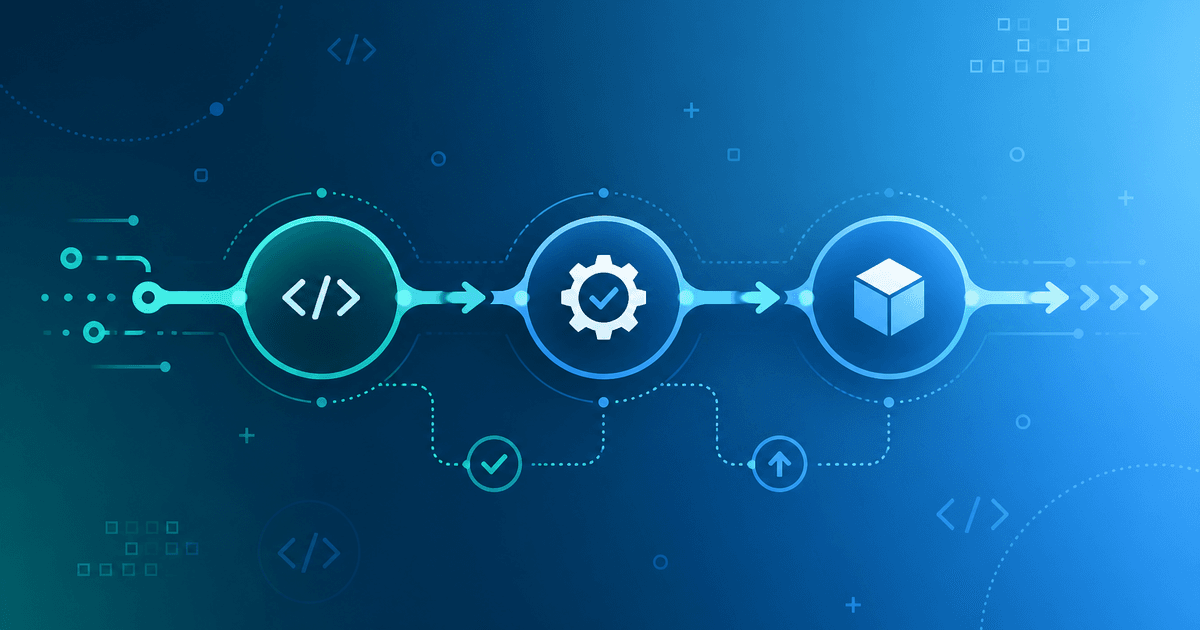
Enterprise DevOps blogs assume a platform team. Most startups have two to five engineers and a product that must ship weekly. CI/CD for startups should be the smallest pipeline that makes releases boring—not a Kubernetes science fair.
Here’s a minimum viable CI/CD setup that actually fits early-stage teams.
Quick answer
You need four things early:
- Automated build + tests on every pull request
- One staging environment that mirrors production enough to catch breaks
- One-button (or auto) deploy to production with rollback
- Basic monitoring + alerts so you learn about outages before Twitter does
If you only have “SSH and hope,” fix that before adding microservices. Architecture choice: monolith vs microservices for an MVP. Broader context: what DevOps is and why it matters.
What CI and CD mean (startup edition)
- CI (continuous integration): Every change is built and checked automatically so main stays releasable.
- CD (continuous delivery/deployment): Passing changes can be released to staging/production safely and repeatably.
Tools vary (GitHub Actions, GitLab CI, etc.). The habit matters more than the logo.
Minimum viable pipeline (2–5 engineers)
| Stage | Do this | Skip this (for now) |
|---|---|---|
| PR checks | Lint + unit/smoke tests + build | Perfect 100% coverage theater |
| Staging | Auto-deploy main to staging | Five regional staging clones |
| Production | Manual approve or auto after smoke | Multi-cloud failover day one |
| Secrets | Env vars / secret store | Keys in the repo “temporarily” |
| Data | Migrations with a plan | Clever hot-swaps without backups |
| Observe | Uptime + error tracking | Full APM suite before users exist |
Staging that is “good enough”
Staging should share:
- Same app version path as production
- Same major config shape (features flags if you use them)
- A database that isn’t production (anonymized or synthetic)
It does not need identical traffic or every third-party webhook. It must catch “we forgot to run migrations” and “the build is broken.”
Tests that matter at startup speed
Prioritize:
- Build succeeds
- Critical path tests (signup → core action → pay if you charge)
- Migration dry-runs when schema changes
- A short smoke test after deploy
Defer:
- Exhaustive UI snapshot farms
- Load tests before you have load
- Custom platform tooling that needs its own roadmap
Deploy and rollback
A good early setup:
- Immutable artifacts (container or build output)
- Same artifact promoted staging → production
- One documented rollback (redeploy previous artifact)
- Feature flags for risky UX when possible
Avoid snowflake servers you can only fix by hand at 2 a.m.
Monitoring: the missing half of CI/CD
Pipelines ship code. Monitoring tells you if users suffer.
Minimum:
- Uptime check on the marketing site and app
- Error tracker (exceptions with alerts)
- SSL expiry alert
- Someone on-call who actually gets the ping
This is core DevOps value—not optional polish.
What to skip until you feel pain
- Multi-cluster Kubernetes
- Service mesh
- Perfect GitOps for five services
- Blue/green in three regions
- Custom internal developer portals
Add complexity when release risk or scale demands it—not because a conference talk did.
30-day startup CI/CD checklist
Week 1: PR pipeline (build + tests)
Week 2: Staging auto-deploy from main
Week 3: Production deploy runbook + rollback drill
Week 4: Uptime + error alerts to a human
How EG Stars helps
We set up practical pipelines and cloud environments for growing products—audit, CI/CD, hardening, monitoring—without enterprise theater. See our DevOps services.
Summary
- Startup CI/CD = safe, repeatable releases, not maximum tooling.
- Start with PR checks, staging, deploy/rollback, and alerts.
- Add platforms when pain is real.
Need a pipeline that matches your stack? Get in touch—we’ll propose a minimal CI/CD path you can run as a small team.