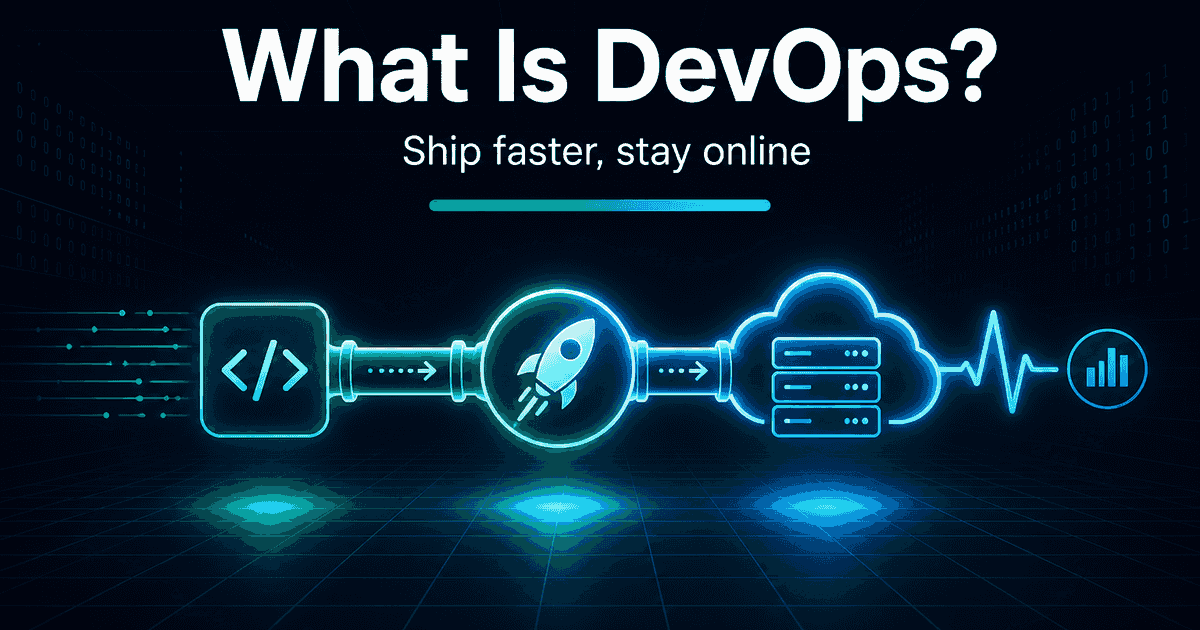
If your product team ships slowly, every release feels risky, or the site goes down and nobody knows until customers complain—you have an operations problem, not just a “coding” problem. DevOps is how modern teams fix that.
This guide explains DevOps in plain language for business owners and managers: what it is, why it matters, and when it’s worth investing in.
What DevOps actually means
DevOps is a way of building and running software so development and operations work as one loop—not two separate worlds that throw work over a wall.
In practice it means:
- New features and fixes reach production safely and often
- Environments (dev / staging / production) are consistent, not “works on my machine”
- Deployments are automated instead of manual late-night uploads
- Systems are monitored, so you catch issues before users flood support
- Security, backups, and scaling are part of the daily process—not an emergency project
DevOps is not a single tool, and it’s not “hire one DevOps person and hope.” It’s a set of practices and infrastructure choices that make your software easier to update and harder to break.
Why it matters to the business (not only engineers)
1. Faster time to market
Without DevOps, a small change can take days: package files, SSH into a server, hope nothing breaks, fix it live. With CI/CD (continuous integration / continuous delivery), tested changes can ship in hours—or minutes—on a repeatable path.
Business outcome: you respond to customers, competitors, and bugs faster.
2. Fewer outages and embarrassing releases
Manual deploys are fragile. Missing a config file, wrong environment variable, or “forgot to restart the service” creates downtime. Automation + staging checks reduce that risk.
Business outcome: less lost revenue, fewer angry reviews, less firefighting.
3. Scale without panic
A campaign, seasonal peak, or viral moment should not take your app offline. Cloud infrastructure and sensible autoscaling (or at least a clear capacity plan) keep you ready for more users.
Business outcome: growth doesn’t become an outage.
4. Lower long-term cost of change
Every manual step is tribal knowledge. When only one person can deploy, you’re one vacation or resignation away from risk. Documented pipelines and runbooks make the company resilient.
Business outcome: you’re not hostage to a single hero engineer.
5. Security and trust
Backups, access control, HTTPS, dependency updates, and monitoring aren’t optional once you handle payments or customer data. DevOps folds these into the release path instead of bolting them on after an incident.
Business outcome: fewer breaches, cleaner audits, and calmer sleep.
Core pieces you’ll hear about
| Term | Plain meaning |
|---|---|
| CI/CD | Automated build, test, and deploy whenever code changes |
| Cloud | Hosting that can grow/shrink and recover without buying a new server every time |
| Containers | Packaging the app so it runs the same in every environment |
| Monitoring & alerts | Knowing CPU, errors, and downtime before customers tell you |
| Infrastructure as code | Servers and config defined in files you can review and reuse |
| Backups & recovery | A tested plan for “what if the database dies at 2 a.m.?” |
You don’t need every buzzword on day one. You need the ones that match your risk.
Signs your business needs DevOps now
Invest sooner if you see:
- Releases happen only on weekends “because they’re scary”
- Production and staging don’t match, so bugs appear only live
- One person holds all server passwords and deploy knowledge
- Downtime is discovered by customers, not by alerts
- You’re launching a mobile app, ecommerce, or SaaS where uptime = revenue
- You’re entering markets (Egypt, GCC, global) where trust and speed matter
If you’re still on a static brochure site with rare updates, full DevOps may be overkill—but basic hosting hygiene (HTTPS, backups, updates) still matters.
What a practical DevOps engagement looks like
For a startup-sized pipeline (not enterprise theater), start with CI/CD for startups.
At EG Stars, DevOps work typically follows a clear path:
- Audit — Current hosting, deploy process, risks, and targets
- Pipeline & infrastructure — CI/CD, containers, cloud resources, environments
- Hardening — Monitoring, alerts, backups, security basics
- Handover — Documentation, runbooks, and optional ongoing ops support
The goal is not enterprise theater. It’s ship faster and sleep better—reliable deployments for the stack you already have (or the one you’re building).
Common myths
- “We’re too small for DevOps.” Small teams suffer most when deploys are manual. Lightweight automation helps earlier, not later.
- “DevOps means Kubernetes everywhere.” Sometimes a solid VPS + CI + monitoring is the right first step.
- “Tools alone fix culture.” Pipelines help; ownership and release discipline still matter.
- “Once set up, we’re done.” Apps grow. DevOps is ongoing maintenance of the path to production.
Summary
- DevOps connects building software with running it—so updates are faster, safer, and more repeatable.
- It matters because it protects revenue, reputation, and delivery speed.
- Start with the basics that match your risk: reliable deploys, environments, monitoring, backups—then grow.
Need reliable deployments for your app or website? Get in touch—tell us your stack and we’ll propose a practical DevOps roadmap.