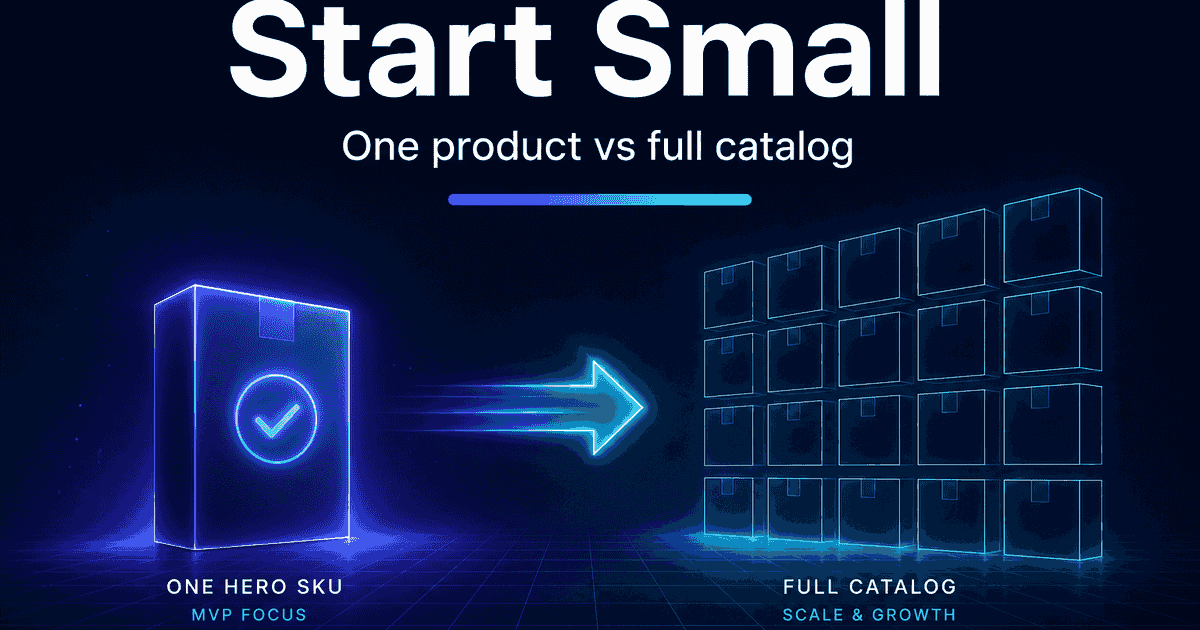
Many businesses delay launching an online store because the catalog isn’t “complete.” Meanwhile competitors sell a single hero product and learn what customers actually buy. The question isn’t “full store or nothing”—it’s one product vs a full catalog: what should you start with?
Here’s how to choose an MVP approach for ecommerce without painting yourself into a corner.
The real goal of a first launch
Your first shop version should prove three things:
- Someone will pay online for what you offer
- You can fulfill the order without chaos
- The checkout path works on mobile in your market
A huge catalog doesn’t prove those faster. Often it slows you down.
When one product (or a tiny range) is the smart start
Start small when:
- You’re validating demand for a new brand or SKU
- Photos, pricing, and shipping aren’t ready for dozens of items
- You have limited time to answer pre-sale questions and pack orders
- You want traffic focused on one clear offer (easier ads and landing pages)
- Variants (size/color) already make “one product” feel like a mini catalog
Example: A skincare brand launches with one bestseller + two sizes. Checkout, payments, and delivery get proven before expanding the line.
When a fuller catalog makes sense from day one
Go broader earlier when:
- Customers expect to browse categories (spare parts, fashion basics, multi-brand retail)
- Your offline stock is already organized and photographed
- Average order value depends on cross-sell (buy A, also need B)
- You’re migrating an existing store and can’t drop half the range overnight
- Wholesale or B2B buyers need assortment to place a real order
Even then, “full catalog” should mean ready products—not placeholders with “coming soon” everywhere.
A practical middle path: focused catalog
Most SMBs win with a focused catalog:
- 5–20 products that are fully ready (media, stock, shipping rules)
- Clear categories (even if only two or three)
- One primary “hero” product featured on the homepage
- A short roadmap for what gets added after the first sales
This looks like a real shop, but stays operationally light.
Comparison at a glance
| Approach | Best for | Main risk |
|---|---|---|
| One product / micro range | Testing demand, tight ops, strong hero offer | Feels too thin if buyers expect choice |
| Focused catalog (recommended default) | Most first launches | Scope creep if you keep adding unfinished SKUs |
| Full catalog day one | Established inventory, browse-heavy categories | Slow launch, messy data, weak ops |
How to decide in one meeting
Ask:
- How many products are truly ready to sell this month (photos + price + stock + ship)?
- Does a typical customer need to compare many options before buying?
- Can your team fulfill 20 orders/week without hiring overnight?
- Will ads or content point people to one offer or to browsing?
- What must be true in 90 days—more SKUs, or more proven sales?
If fewer than ~10 SKUs are ready, start small. If customers can’t buy without browsing a category, prioritize a focused set in that category—not the whole warehouse.
What “starting small” still requires
A small launch is still a real store. You still need:
- Secure checkout and trusted payment methods
- Shipping / returns rules
- Mobile-friendly product and cart pages
- Basic policies and a support channel
- Analytics to see where people drop off
Starting small is about catalog scope, not skipping fundamentals. Pair this with our checklist: what you need before launching an online store.
How to grow from one product to a catalog
A clean growth path:
- Launch the hero offer and fix checkout friction
- Add the 2–3 products customers ask for most
- Introduce categories when navigation gets noisy
- Connect inventory seriously when SKU count or warehouses grow
- Only then invest in heavy merchandising and personalization
Don’t rebuild the store every time you add a product—design the first version so catalog growth is normal.
How EG Stars helps
We build ecommerce shops that can start focused and scale: clear product pages, secure checkout, order/inventory flows, and mobile-first UX. Whether you begin with one SKU or a curated range, we plan the store so expansion doesn’t mean starting over.
Summary
- One product is a valid MVP when you’re testing demand and keeping ops simple.
- Full catalog fits when assortment and browse behavior are core to buying.
- Most businesses should start with a focused, fully ready catalog—and expand from real sales.
Not sure whether to launch lean or wide? Get in touch—we’ll help you pick a first catalog scope, timeline, and store setup that can grow with you.