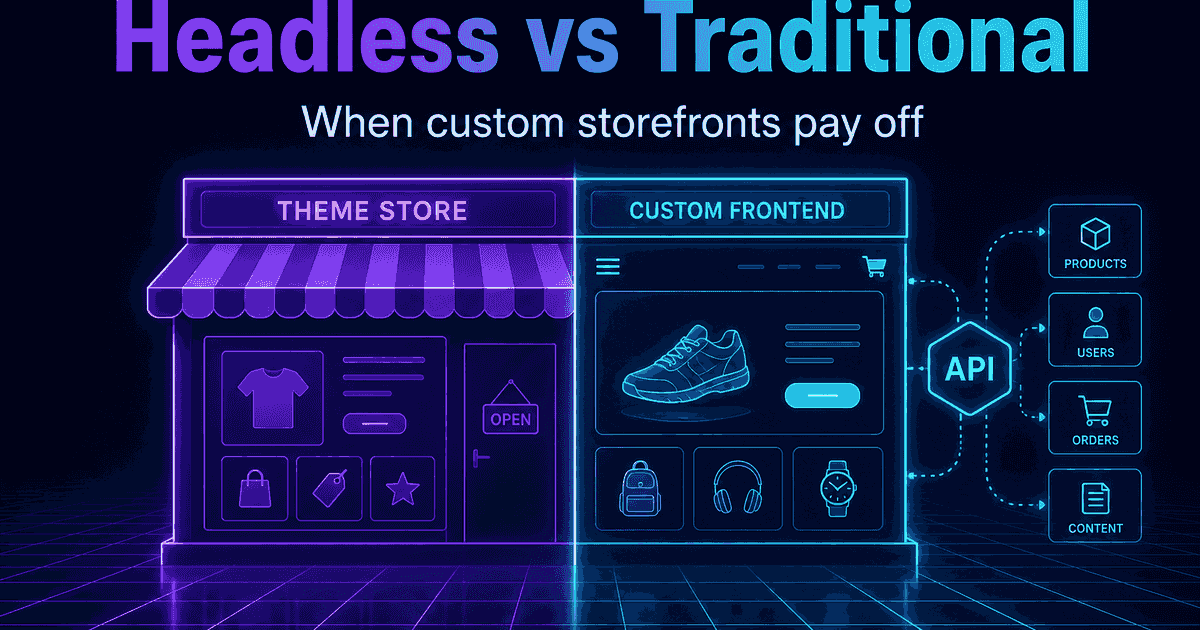
Headless ecommerce separates your storefront (what shoppers see) from the commerce engine (catalog, cart, checkout, orders). Traditional platforms keep theme + commerce in one system. Headless can be faster and more flexible—or an expensive SEO and maintenance trap.
Here’s when headless is worth it for a growing store, and when you should stay traditional.
Quick verdict
| Choose… | When… |
|---|---|
| Traditional (theme-based platform) | You’re under ~$1M online revenue, need speed to market, and organic SEO must “just work” |
| Headless / custom storefront | You need unique UX, omnichannel, or performance beyond theme limits—and you can fund engineering |
| Hybrid | Keep platform checkout/catalog; customize key landing or brand experiences first |
For catalog scope before any rebuild, see one product vs full catalog and what to prepare before launching a store.
What “headless” means in practice
- Traditional: Shopify/Woo/similar theme renders pages; platform handles much of SEO, cart, and apps.
- Headless: Frontend (often Next.js, Astro, Remix, Hydrogen-style) talks to commerce APIs; you own URLs, rendering, schema, and performance.
Headless is not automatically “more modern.” It’s more responsibility.
Comparison table
| Factor | Traditional | Headless |
|---|---|---|
| Time to launch | Days–weeks | Months (often 3–7+) |
| Upfront cost | Lower | Higher engineering |
| SEO defaults | Built-in sitemaps, meta, much schema | You build SSR/SSG, schema, sitemaps, canonicals |
| Design freedom | Theme-constrained | Near-unlimited UI |
| Performance ceiling | Good with care | Excellent if SSR/SSG done right |
| Maintenance | Apps + theme updates | Frontend deploys + API changes |
| Best fit | SMBs, first serious stores | Complex brands, high traffic, custom UX |
The SEO risk nobody markets
Traditional platforms generate a lot of SEO plumbing automatically. Headless drops that unless your team implements:
- Server-side or static rendering (not pure client-only SPAs)
- Product/Offer/Breadcrumb JSON-LD
- XML sitemaps and canonical rules
- Redirect maps on migration
- Fast LCP/INP on real mobile networks
Sloppy headless migrations often lose 20–40% organic traffic. Done well, Core Web Vitals and URL control can outperform themes. The difference is discipline—not the buzzword.
When traditional wins
Stay on a solid theme/platform when:
- You need sales this quarter, not a platform rewrite
- Catalog and checkout are standard
- You don’t have (or want to hire) frontend specialists
- Paid ads / social drive more revenue than organic (for now)
- Your team’s bottleneck is merchandising, not pixel-perfect UI
A fast traditional store that sells beats a glamorous headless project that ships late.
When headless (or custom) is worth it
Consider headless when several are true:
- Theme apps and liquid/PHP hacks are blocking growth
- You need highly custom browse/PDP/checkout UX
- Omnichannel or content-heavy storytelling is core
- You already have engineering capacity or a partner
- Organic search is critical and you’ll fund SEO properly in the build
- Performance on mobile is a measurable conversion problem
Custom ecommerce development can also mean a purpose-built store without full “composable commerce” complexity—choose the smallest architecture that hits the goal.
Cost and timeline (honest bands)
| Approach | Rough build band | Notes |
|---|---|---|
| Traditional setup + theme polish | Lower (weeks) | Apps/plugins add cost and risk |
| Headless storefront on existing commerce backend | Higher (months) | Frontend + SEO + integrations |
| Full replatform + headless | Highest | Migration + redirects + data |
Pair with payment model choices: hosted vs embedded vs API.
Decision checklist
- What’s broken today—design, speed, SEO, ops, or just FOMO?
- Can we name revenue or conversion upside that pays for 3–6 months of build?
- Who owns SSR, schema, and sitemaps after launch?
- Are we migrating URLs with a redirect plan?
- Is phase 1 a full rewrite—or a high-value custom experience first?
Related guides
- Multi-currency checkout best practices
- Core Web Vitals checklist for business websites
- Payment integration types
How EG Stars approaches it
We recommend traditional when it converts faster, and custom/headless when UX or scale demands it—with SEO and payment integration planned in from day one, not bolted on after design.
Summary
- Traditional = faster, safer SEO defaults, less freedom.
- Headless = freedom and performance ceiling, higher cost and SEO ownership.
- Choose based on constraints and upside, not trend slides.
Considering a storefront rebuild? Get in touch—we’ll assess fit, risks, and a phased path that won’t tank your organic traffic.