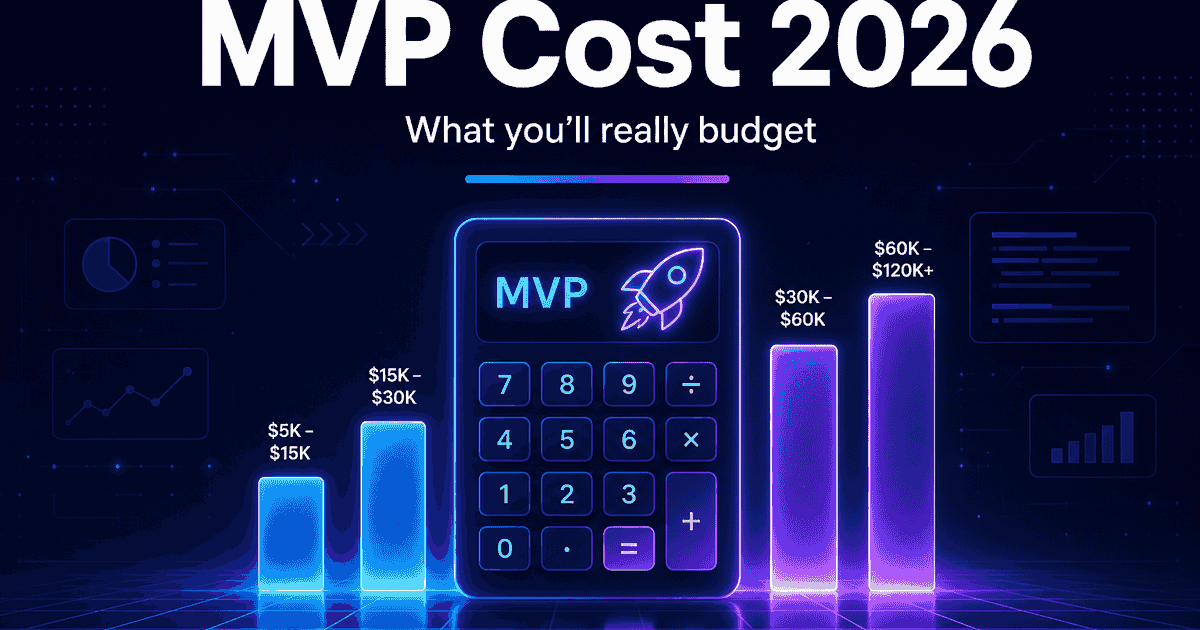
MVP development cost in 2026 typically falls between about $15,000 and $150,000+ USD, depending on scope, platforms, integrations, and who builds it. Most focused B2B web or mobile MVPs land closer to $25,000–$80,000 when the feature list stays honest.
That range is wide on purpose. “MVP” means different things to different people. This guide breaks down what you actually pay for, what to cut for phase 1, and how to spot quotes that are too cheap to succeed.
Quick answer: cost bands by MVP type
| MVP type | Typical budget (USD) | Typical timeline |
|---|---|---|
| Simple web MVP (auth + 1–2 core workflows) | ~$15,000–$40,000 | ~6–10 weeks |
| Standard SaaS / web app MVP | ~$25,000–$80,000 | ~8–16 weeks |
| Cross-platform mobile MVP (Android + iOS) | ~$35,000–$100,000+ | ~3–5+ months |
| Complex MVP (heavy integrations, roles, payments, compliance) | ~$80,000–$150,000+ | ~4–6+ months |
These are planning bands, not fixed prices. A written scope always beats a blog table. For calendar ranges by product type, see how long a website or app takes.
What “MVP” should mean (so the quote makes sense)
A real MVP is the smallest product that proves one valuable outcome with real users—not a half-built final vision.
Good MVP scope usually includes:
- One primary user journey that works end-to-end
- Accounts / auth if the product needs them
- A basic admin or ops path so you can run the business
- Staging + production deploy (not “works on my laptop”)
- Analytics or logging so you can learn
It usually excludes: every edge case, polished multi-role permissions, every integration, native apps on two platforms plus a full marketing site plus AI features—unless those are the core bet.
If your “MVP” list looks like a year-two roadmap, your cost will look like one too.
What drives MVP development cost
1. Feature complexity (the biggest lever)
Each workflow, role, and exception adds design, build, and test time. Cutting 30% of features often cuts far more than 30% of cost because integrations and edge cases compound.
2. Platforms
- Web only is usually cheapest to validate.
- Android + iOS (especially cross-platform) costs more than web alone.
- Web + mobile in one phase is rarely a true MVP unless both are required to sell.
3. Integrations
Payments, ERPs, CRMs, SMS/email providers, maps, and KYC checks add calendar time and risk. Each external system needs error handling, webhooks, and testing—not just “connect the API.”
4. Design depth
A clean, consistent UI costs less than custom illustration-heavy branding and complex motion—but zero design often costs more later in rework and churn.
5. Team model and geography
- Freelancers: lower day rates, you own coordination risk.
- Agency / product team: higher rate, structured delivery, PM + QA included.
- Location matters: global delivery teams can reduce cost versus US/UK-only rates without meaning “cheap and careless”—if process is solid.
6. Quality bar at launch
CI/CD, staging, basic security, and monitoring add budget up front and save emergency spend later. Skipping them is how “cheap MVPs” become expensive.
Typical budget breakdown (where the money goes)
For a mid-range SaaS-style MVP (~$40k–$80k), allocation often looks like:
| Phase | Share of budget | What you get |
|---|---|---|
| Discovery & scope | ~10–15% | Goals, user stories, MVP cut line |
| UX/UI | ~15–25% | Key screens, flows, mobile-first UI |
| Development | ~40–55% | Frontend, backend, database, APIs |
| Integrations | ~5–15% | Payments, email, third parties |
| QA & launch | ~10–15% | Test cycles, bugfix, go-live |
| DevOps / deploy | ~5–10% | Environments, CI/CD, monitoring basics |
The most underfunded line in bad quotes is almost always QA + deployment. If a proposal puts ~5% on testing and launch infrastructure, ask why.
Agency vs freelancer vs in-house
| Model | Best when | Main risk |
|---|---|---|
| Freelancer(s) | Narrow scope, you can manage tech decisions | Coordination, bus factor, uneven QA |
| Agency / studio | You need a team, process, and accountable delivery | Higher sticker price if scope is fuzzy |
| In-house hire | Long-term product company building continuously | Slow to first ship; hiring cost is not “MVP price” |
For most first-time founders, a structured app development partner costs more per hour than a solo freelancer—and less than a failed or unmaintainable build.
Red flags in “cheap MVP” quotes
Walk away or renegotiate when you see:
- Fixed price with no written MVP boundary
- No staging environment or test plan
- “Unlimited revisions” with no definition of done
- Every competitor feature promised in eight weeks
- No ownership clarity (source code, hosting, accounts)
- Payment integrations “later” with no architecture for them
Cheap is fine when scope is tiny. Cheap + ambitious is how budgets explode mid-project.
How to lower cost without killing the product
- One persona, one job-to-be-done for v1
- Web first if mobile stores aren’t required to learn
- Buy auth/email/payments building blocks; build your differentiator
- Manual ops beats custom admin for the first 50 users when possible
- Phase 2 parking lot—write ideas down; don’t build them yet
- Decide cross-platform vs native only when mobile is mandatory — or compare Flutter vs React Native and PWA vs native
- For broader builds, see custom software development cost
What to prepare before asking for a quote
You’ll get a tighter number when you bring:
- Problem statement and target user
- Must-have vs nice-to-have list
- Platforms (web / iOS / Android)
- Must-connect systems (payments, ERP, etc.)
- Budget ceiling and launch deadline
- Who approves scope on your side
Related prep guide: what to prepare before a website or app.
FAQ
Is $10,000 enough for an MVP in 2026?
Sometimes—for a very small web tool with minimal design and almost no integrations. It is rarely enough for a polished multi-platform product.
Does no-code change the numbers?
No-code can validate faster at the low end. Many products still outgrow it; factor rebuild risk into the “cheap” path.
What about ongoing cost after launch?
Plan roughly 15–20% of build cost per year for maintenance, hosting, fixes, and small iterations—more if you ship continuously.
Architecture tip: most MVPs should stay a modular monolith, not microservices until real scale or team pain forces a split.
How EG Stars estimates MVPs
We scope phase 1 around a real learning goal: discovery, UX for the core journey, build, integrations you truly need, QA, and a deploy path you can run. You’ll see what is in MVP versus what waits—so the number matches the product, not a wish list.
Summary
- Most MVPs in 2026: roughly $25k–$80k; simple lower, complex higher.
- Cost follows scope, platforms, integrations, and quality bar—not a single magic rate.
- The cheapest quote wins only if the MVP boundary is real and delivery is accountable.
Want a realistic number for your idea? Get in touch—share your must-haves and constraints, and we’ll propose a phase-1 MVP scope and budget band.