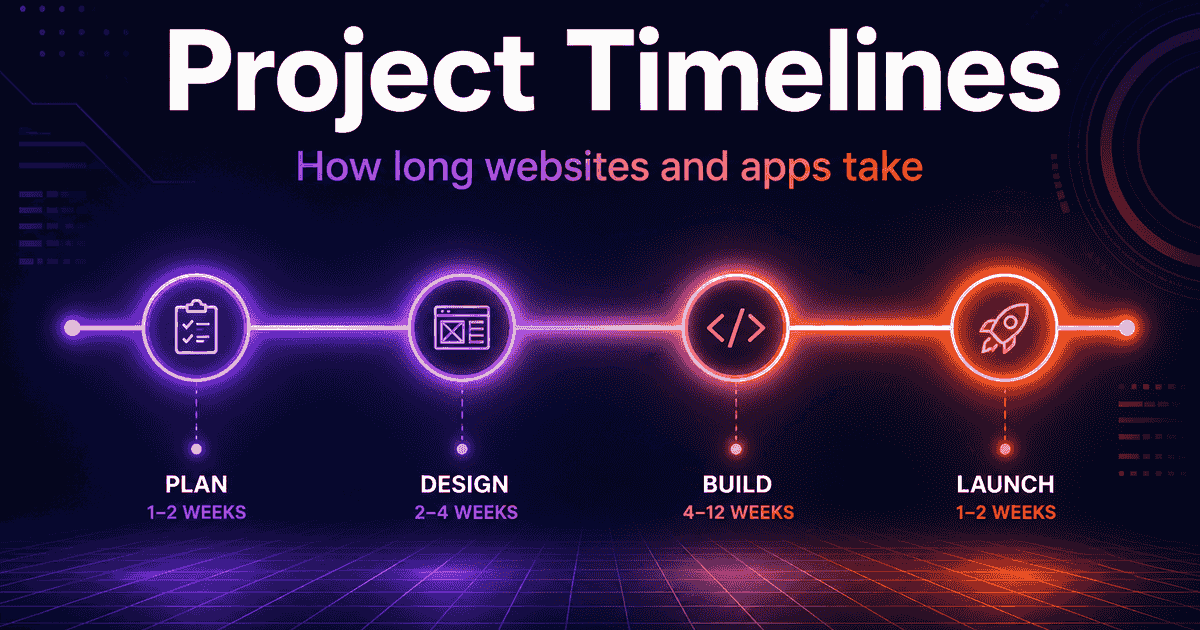
“How long will it take?” is usually the second question after budget. Honest answer: it depends on scope, content readiness, and integrations—but you can still use rough ranges to plan.
Here are practical timelines for common EG Stars project types, and what makes delivery faster or slower.
Quick ranges (calendar time)
These assume a clear brief, responsive feedback, and content that isn’t starting from zero. Complex custom work or slow approvals stretch every estimate.
| Project type | Typical range | What’s usually included |
|---|---|---|
| Landing page | ~1–3 weeks | One focused page, clear CTA, basic SEO, mobile-first layout |
| Business website (several pages) | ~3–8 weeks | Home + key pages (about, services, contact), forms, bilingual adds time |
| Ecommerce store (focused catalog) | ~6–12+ weeks | Catalog, cart, checkout, payments, shipping rules, admin basics |
| Web app / portal MVP | ~2–4+ months | Auth, core workflows, API/backend, staging, iterative UAT |
| Mobile app MVP (Android + iOS, cross-platform) | ~3–6+ months | Core features, API, store prep, device testing—not every nice-to-have |
| Odoo implementation (phased) | ~1–4+ months | Scope-dependent: modules, data migration, training, go-live |
Treat these as planning bands, not fixed contracts. A written scope always beats a blog table.
What a healthy timeline actually includes
People often count only “coding days.” Real delivery includes:
- Discovery — goals, users, sitemap / feature list
- Design — UX/UI for key screens (especially mobile)
- Build — frontend, backend, CMS/admin as needed
- Integrations — payments, email, ERP, gateways
- Content — copy, images, Arabic/RTL if required
- QA — devices, browsers, test transactions
- Launch — DNS, analytics, training, hypercare
Skipping discovery rarely saves time—it moves rework to the end.
What speeds projects up
- A decision-maker who answers within 1–2 business days
- Content and brand assets ready (or clearly “we’ll use placeholders until date X”)
- A short MVP list—and a parking lot for phase 2
- Fewer exotic integrations in version one
- One source of truth for requirements (not conflicting WhatsApp threads)
What slows projects down
- “Can we also add…” every week without re-scoping
- Waiting on product photos, legal pages, or gateway accounts
- Changing direction after design is approved
- Unclear ownership between your team and the vendor
- Treating store submission or data migration as day-one surprises
Landing page vs full website vs app
- Choose a landing page when you need one offer live fast (campaign, waitlist, lead magnet).
- Choose a full website when you need trust, SEO pages, and multiple services explained.
- Choose an app when users must log in and complete ongoing tasks—not when a site form would do.
If you’re torn between page and site, start here: landing page vs full website.
How to use these ranges in a sales conversation
Ask any partner (including us):
- What’s in phase 1 vs later?
- What do you need from us by which dates?
- Which dependencies are outside your control (banks, Apple/Google, third-party APIs)?
- How do change requests affect the date?
- What does “launched” mean—staging demo or production with real users?
Clear answers beat optimistic promises.
How EG Stars works with timelines
We scope deliverables and sequence work so you see progress in stages—not a black box until the last week. For apps, ecommerce, Odoo, and DevOps-heavy launches, we call out integration and content risks early.
Summary
- Landing pages can ship in weeks; meaningful apps usually need months.
- Timeline quality depends on scope discipline and your feedback speed as much as engineering.
- Use ranges to plan—and a written MVP to commit.
Want a timeline for your project? Get in touch—share your goals and constraints, and we’ll propose a realistic phase-1 plan.